 Flushodds
The Solver
Your hand against theirs, preflop to the river.
Two players, one board, and a genuine counterfactual-regret solve — computed on your device, in seconds, with its own error bars reported next to the answer.
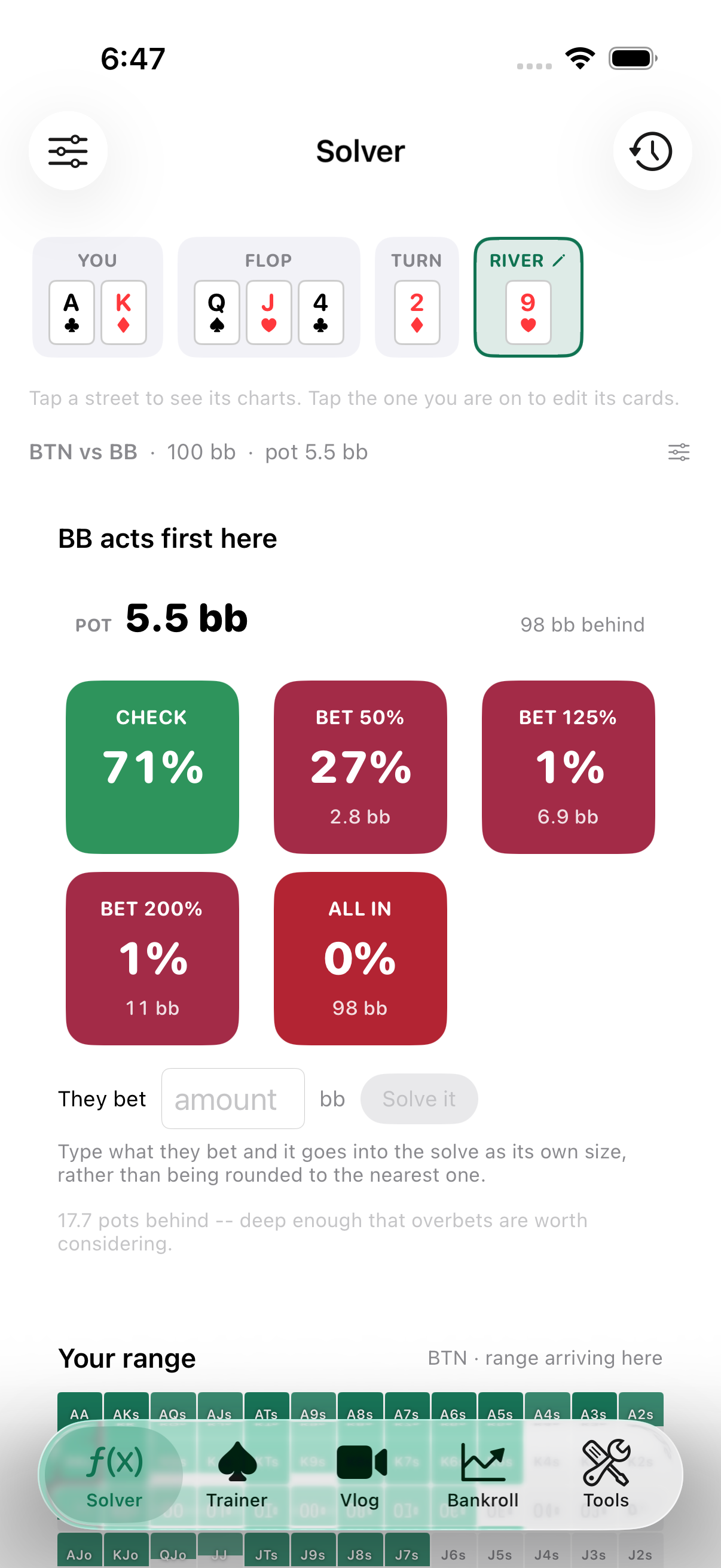
The answer for the hand you are actually holding
Tap in your cards, then the flop, turn and river as they come. The blocks are what to do with your exact hand — how often, and for how much.
- Preflop through the river on one screen
- The running pot carried down every street
- Sizes from the stack-to-pot ratio, not a fixed 2.5bb for everything
- Green is passive, wine through crimson is aggression, deeper means bigger
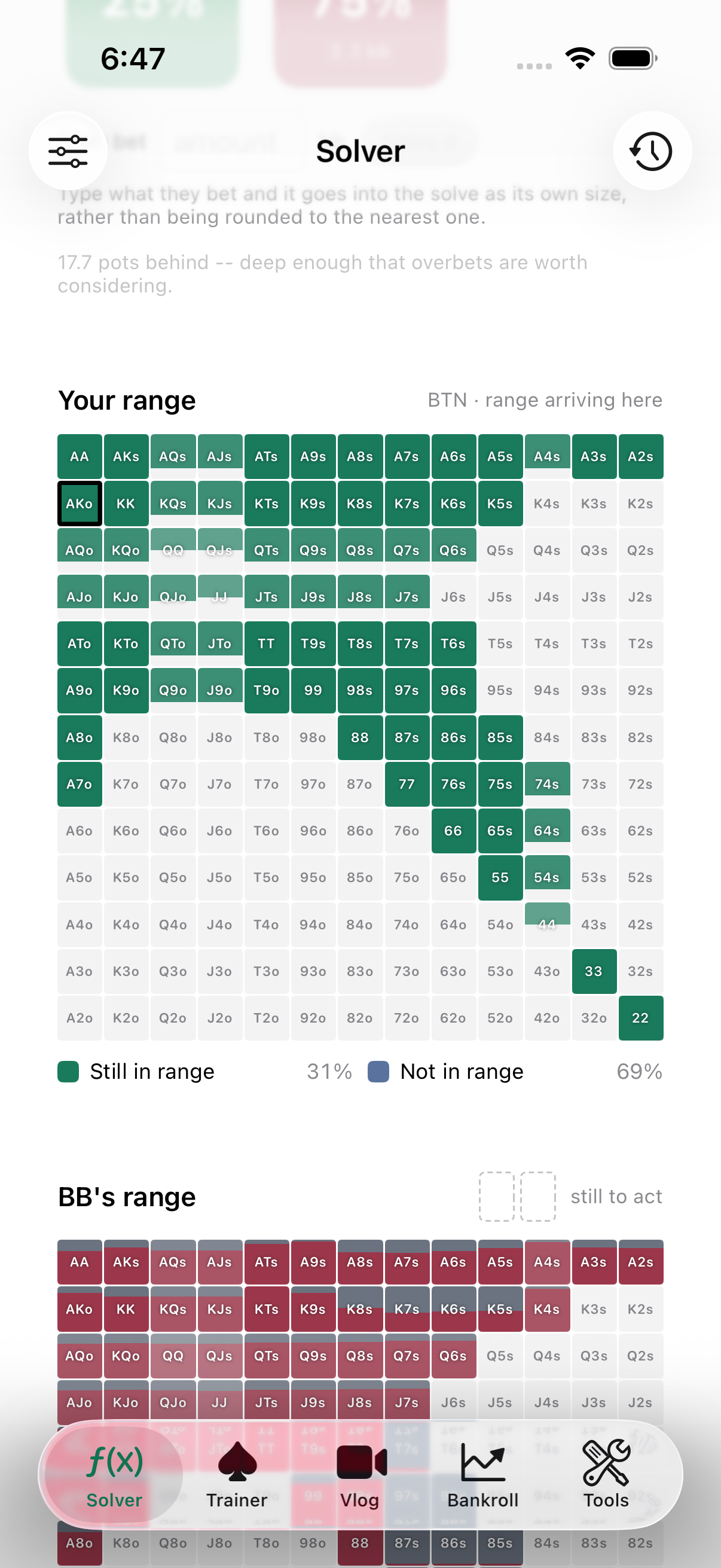
Both ranges, on every street
Each of the 169 cells is filled in proportion to how often that hand takes each action, so a pure call never looks like a half-raise mix.
- Your chart and your opponent's, together
- Your hand outlined even once it has dropped out of the range
- Tap any cell to magnify it — the page still scrolls
- A hand outside your range is an answer, not an error
What is actually under it
Discounted CFR
A real solve over a real betting tree, with exploitability reported so you can see how solved the answer is.
It never refuses
If a spot will not fit your device the betting abstraction steps down until it does, and the app tells you exactly what it gave up.
Their real bet size
They bet 4.2bb? That exact number becomes a branch in the tree. Rounding it to “75% pot” answers a different question.
Exact hand evaluation
Checked against all 2,598,960 five-card hands, matching the textbook frequency for every category.
Nash push/fold
Short-stack shove and call ranges solved on your device for any seat at a 2–9 handed table, with antes and ICM.
Nothing leaves
Every solve runs locally. On a plane, in a basement card room, on aeroplane mode.
The solver is exactly two players. A third player stops it being a zero-sum game and puts the tree far beyond a phone. That lives in the Trainer instead, as equity against the field — labeled as equity, never dressed up as a solve.
Deep preflop raising ranges are published charts, not solves, and every screen that uses one says so. Short-stack shove/fold is solved, and is labeled differently.
A flop against wide ranges is simplified. At full detail it needs about 1.35 GB. Turn and river solves run at full detail.