 Flushodds
The Bankroll
What you are actually worth, to the penny.
Two numbers that are easy to confuse and should never be: what is in your pocket, and what you have actually won.
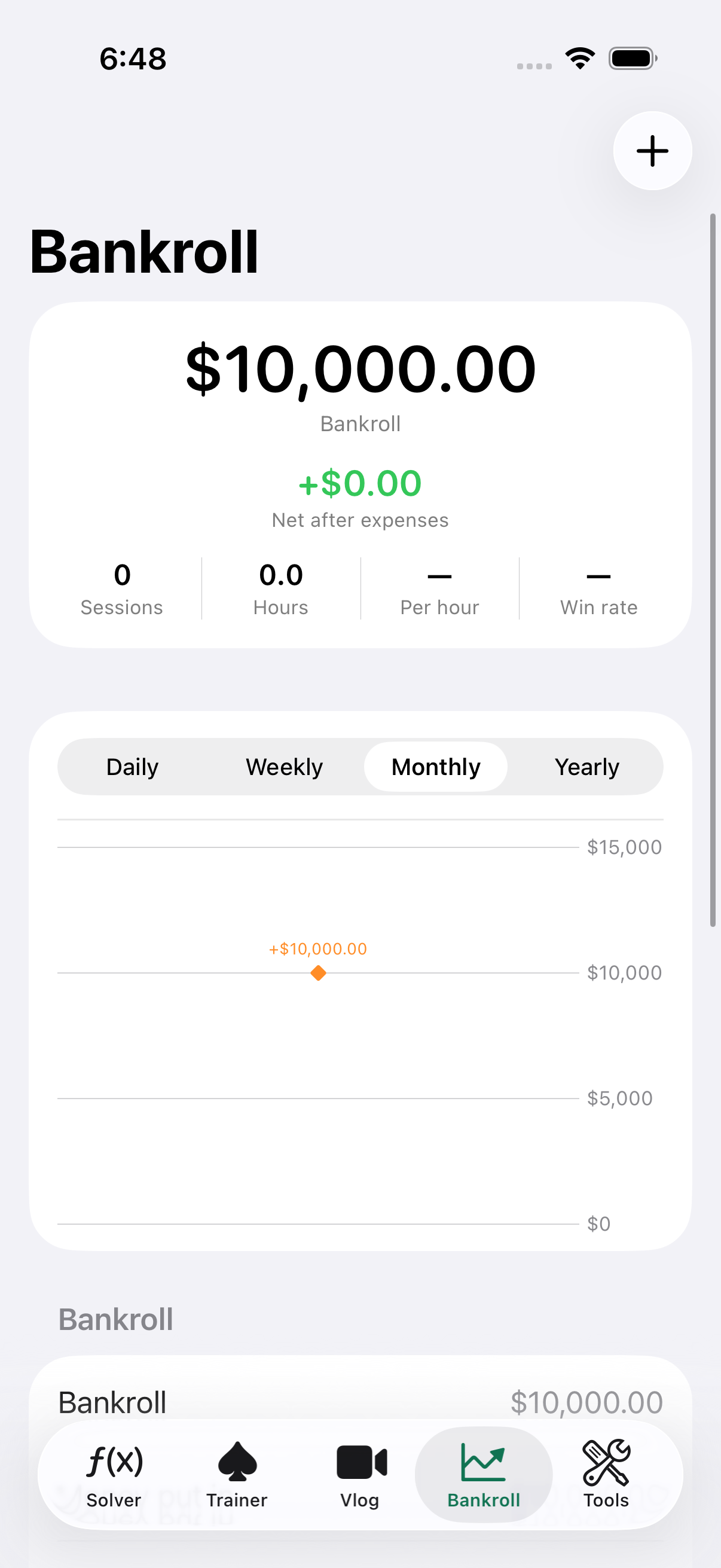
Money in is not a win
Set an opening balance and add funds whenever you like without playing a hand. Deposits move your balance and never touch your win rate.
- Sessions, rebuys, cash-outs and expenses
- Hourly rates from the time you actually sat down
- A second opening balance corrects the first rather than adding to it
- A session counts once you end it — a game you are still sitting in has not won or lost anything yet, so it stays out of the totals until then
- Starting a vlog can open a matching session, already running
- Daily, weekly, monthly and yearly rollups by game and venue
- Rooms picked from a list you build, so the venue breakdown is not split across three spellings of the same cardroom
For your accountant
A month, a quarter or a year, as two files written on your device and shared by you.
A PDF
The summary, every session and every expense, laid out for somebody who does not play poker.
A real spreadsheet
A genuine .xlsx with three sheets — the summary and the two ledgers behind it — so the numbers can be checked, not taken on trust.
It states its own basis
The dates it covers, the currency, when it was generated, and what it left out.
Playing abroad
Record a session in the currency you played in and lock the exchange rate you actually got. Rates are stored per row and never fetched: there is no server to fetch from, and a floating rate would restate last year's trip every time the market moved.
A row it cannot convert is held back and counted, never guessed at. A session in euros with no locked rate is excluded from the totals and the report says so — because a total that quietly drops a session is worse than one that admits it.
Every amount is exact decimal arithmetic, not floating point, so a year of sessions still adds up to the cent.